
Asbestos Floor Tiles - Are they safe to handle and remove?
Asbestos floor tiles were widely used during construction in Australia from the 1950s right the way through to the mid-1990s.
If you are looking to renovate any home constructed during this time, it’s important to understand what you’re up against, the precautions that you need to take, and how to safely handle and remove asbestos floor tiles.
This no-nonsense guide will run you through everything you need to know about asbestos floor tiles including how to identify them, the risks involved, and whether you should be tackling this by yourself or calling in the professionals.
How common are asbestos floor tiles in Australia?
Asbestos floor tiles are extremely common in Australia.
If your home was constructed between 1950 and the mid to late 1990s – there is a chance that your floor tiles or floor lining may contain asbestos material.
Asbestos floor tiles were widely used during construction in the second half of the 20th century because they were relatively cheap, fire resistant, and – for much of the time – the damaging impact of asbestos in homes was not properly understood.
Of course, by the late 1980s the effects of asbestos were widely documented, and any subsequent use was largely driven by wilful ignorance and cost-saving measures at the expense of the end consumer. Asbestos was not banned until the end of 2003 by which time asbestos had been used in countless homes and construction projects across Australia.
Where were asbestos floor tiles most commonly used?
Asbestos floor tiles were widely used in both residential and commercial buildings.
In the home/property
Whilst it depends on your building, asbestos floor tiles were most commonly used in high traffic areas that were prone to moisture. Think spaces like kitchens, bathrooms, and laundries. Asbestos was most commonly used in the backing of vinyl sheets, vinyl floor tiles, as well as in the water-resistant wall panels in bathrooms and kitchens (including splashbacks).
Outside of the home/property
Travel time and location of the property will play a role in the end cost of asbestos removal in Australia. Properties in metro locations that require less travel time will typically be cheaper than those in non-metro or remote destinations that require added travel time.
Is it safe to handle asbestos floor tiles?
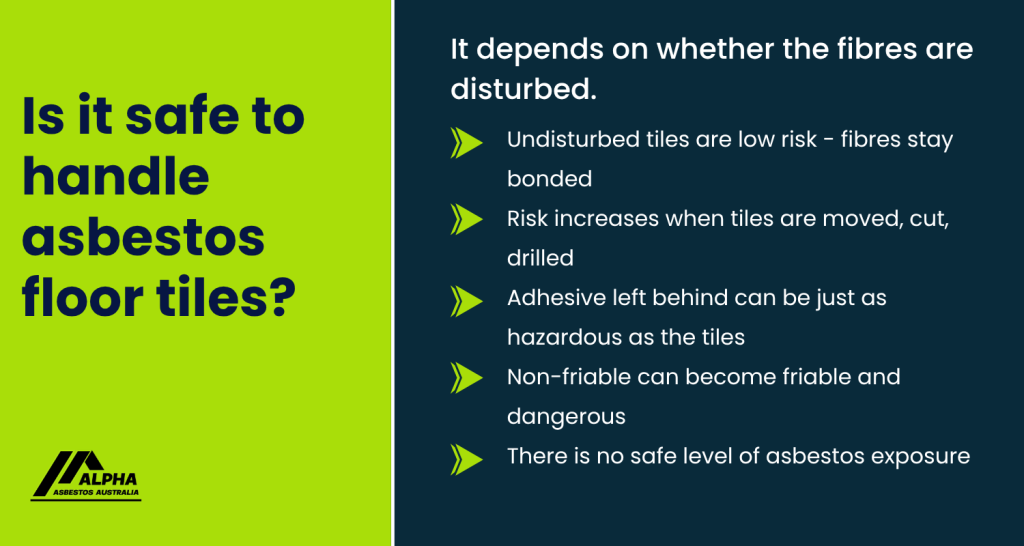
The short answer is; it depends.
Asbestos floor tiles are usually classified as a non-friable asbestos containing material meaning that the asbestos fibres are bonded to the vinyl or polymer rather than in a loose format like debris. In most cases, that means asbestos floor tiles – when left undisturbed – are relatively low risk compared to other materials like insulation or construction debris.
If the fibres remain sealed and undisturbed in a non-friable state, then they would generally be classified as a low risk.
With that said, it’s important to understand two things:
- Asbestos containing materials may not be limited to the floor tiles themselves – adhesive materials which were once used to bond tiles to the floor or wall may also contain asbestos and pose a serious risk.
- When you start construction, there is a high chance that fibres can become disturbed and move from being non-friable to friable – posing a direct risk to inhabitants and those working on the site.
In practical terms, asbestos floor tiles when left undisturbed and handled with care may not cause any issues. However, without proper care and due diligence, things can go south very quickly, and “safe” non-friable asbestos tiles can become friable and cause a serious health risk.
Is it safe to handle non-friable asbestos floor tiles?
Again, it depends.
When left undisturbed and undamaged, asbestos floor tiles may be safe to handle. However, breaking, disturbing, or even improper moving of asbestos floor tiles can release dangerous fibres which can cause serious problems.
DIY asbestos floor tile removal – yes or no?
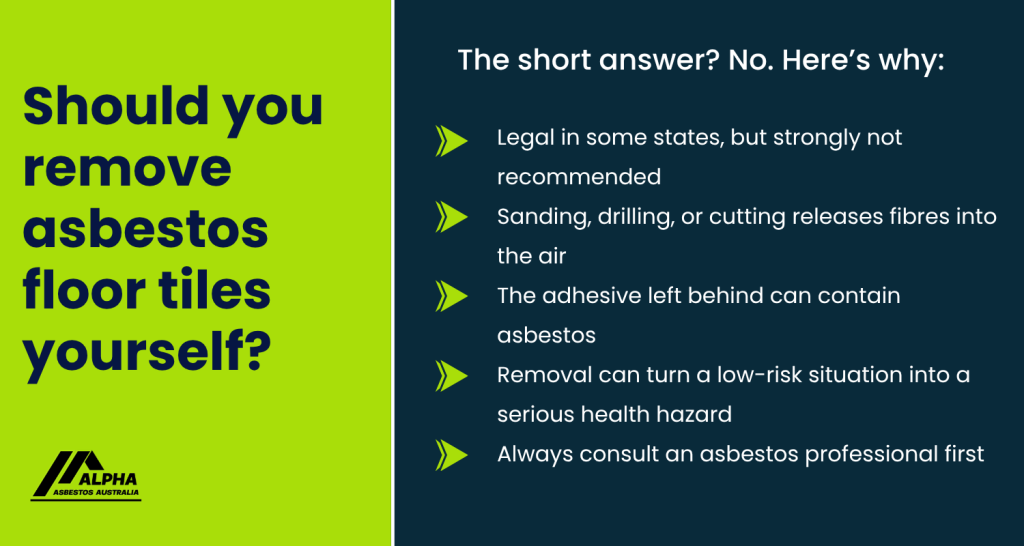
The straightforward answer is that whilst it may be legal in some states and territories, it is strongly advised that you do not handle or attempt to remove asbestos floor tiles without checking with an asbestos removal professional first.
The simple reason is that the damaging part of asbestos floor tiles may not actually be the tiles themselves – it could be the adhesive. As such, it adds a further layer of complication when you remove the tiles and then have an adhesive left behind which may require surface preparation or drilling during construction.
Sanding, drilling, or cutting into asbestos tiles can release asbestos fibres into the air. Once these fibres become airborne, they pose a serious health risk to anyone in the area – there is no safe level of asbestos exposure.
The simple answer is that handling or removing asbestos floor tiles is not advised. If you suspect that you have asbestos floor tiles or adhesive that was once used for these tiles, then you should stop and get in touch with an asbestos professional immediately. Before proceeding, an asbestos professional will be able to assess, test, and provide an action plan to mitigate risk.
Don’t be sorry – be safe.

⭐⭐⭐⭐⭐ Rated & Trusted
by Satisfied Customers